
It's Over
As ministers and MPs call for him to go Starmer's departure is only a matter of time

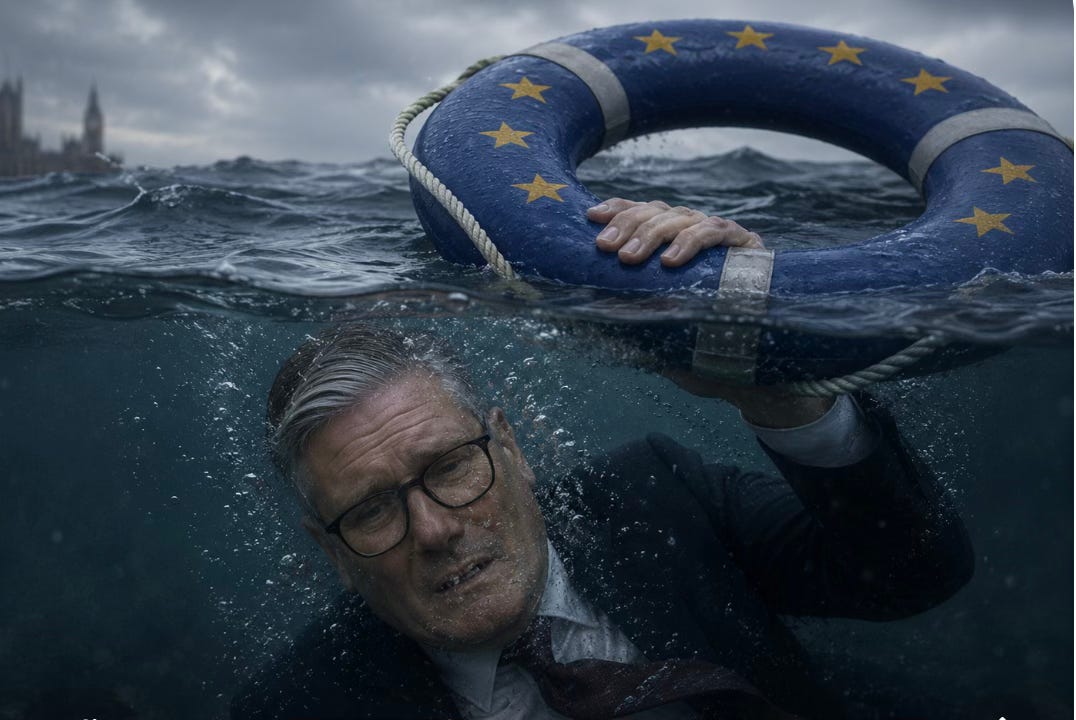
Keir Starmer delivered his make-or-break speech today, shirt-sleeved and without notes, trying to speak from the heart. It broke him.
At the time of writing, 70 Labour MPs have now called for a timetable for their own Prime Minister, four ministerial aides have resigned, and three cabinet ministers, including the Home Secretary, Shabana Mahmood, have expressed concern.
“It’s over,” said the Labour MP Jonathan Pinder on BBC Newsnight. “No prime minister can survive this... It’s time to be real. He’s going… his speech was tone-deaf.”
Mr Pinder identified Starmer’s peak tonal hearing loss as the passage when he effectively began a new war over Brexit and an extension of freedom of movement to young people. Starmer had said his aim was to restore Britain to “the heart of Europe”.
Anyone with a decent memory of UK politics will recognise that as an echo of the Conservative Prime Minister, John Major, in 1992, when he defied his rebellious Eurosceptic MPs and took Britain into the Maastricht Treaty. That was the treaty that established the modern European Union with its common currency, the euro, and its single market in goods and services. Ever since, it has been the rallying cry of those who wished to remain in the EU and want Britain to return to it. It was an astonishing way for Starmer to try to relaunch his party.
Perhaps, as with that comment last year when he said Britain was becoming “an island of strangers”, he did not fully appreciate the resonance of what he said. He resiled from the “strangers” speech; he cannot resile from this. Then again, perhaps he won’t have to, because Starmer may not be long for this world.
A FIGHTER, NOT A QUITTER?
We are told that Sarmer is refusing to give up, that his back is against the wall, that he has no intention of quitting in the middle of an economic crisis. Did the “alliance of naysayers”, as he called his critics in his speech, not remember the chaos of the Tory years when they seemed to change prime ministers almost by the month? What about the bond markets? This uncertainty risks another Liz Truss-style financial crisis as the markets lose confidence in the UK’s ability to manage its affairs — from the top down.
Moreover, say those reluctant to call for Starmer to go, who is going to replace him? Can anyone imagine Angela Rayner negotiating with Donald Trump or winning the support of the bond markets? At the weekend, she called on Starmer to increase the minimum wage and boost spending to “put money in working people’s pockets”. She must know that this would mean another round of tax increases, which have already stifled growth and taken money out of working people’s pockets.
The other left-wing challenger, the Mayor of Manchester, Andy Burnham, isn’t even in Parliament. Somehow a safe seat would have to be procured for him by an existing Labour MP resigning. But that would mean a by-election in the middle of a leadership crisis, which could go disastrously wrong if the voters decided to use it to send a message to the Labour Party that they are disgusted with their shenanigans.
The candidate of the soft right, the Health Secretary Wes Streeting, has been keeping his cards very close to his chest. He is definitely on manoeuvres, but is hoping that the crown will fall to him without his having to actually call for Starmer to go. There is an old saying that he who wields the knife rarely wears the crown. If the required 80 Labour MPs write to the Parliamentary Labour Party and call for a leadership election, then he will definitely be on the ticket. But he doesn’t want to be seen to be the ringleader of a palace coup.
BRITAIN’S PERMA-CRISIS CONTINUES
And so Britain enters another phase of the perma-crisis that has been causing political instability really since the financial crash in 2008. That was when everything started to go wrong at once. Wages began a freeze that has yet to end, the longest period of near-zero growth in earnings since the Napoleonic Wars. The Conservatives launched an austerity programme that made matters worse.
Then the Brexit referendum split the country from top to bottom between Remainers and Brexiteers. The former were the predominantly middle-class, university-educated managerial elite, sometimes called the “lanyard classes”; the latter were predominantly working-class people living in the provincial towns and cities left behind by the enduring economic malaise and marked by largely unassimilated immigrant communities.
That division was exacerbated by the coronavirus pandemic, in which the professional classes largely worked from home while the working classes — nurses, shop workers, firefighters etc. — had to go to work. The energy crisis that followed the Ukraine war made home heating unaffordable and petrol ruinously expensive. Inflation approaching 50% in food prices since the pandemic put the tin hat on it.
Labour were elected with a landslide to deliver change, stability and economic growth. But nothing changed and Keir Starmer rapidly lost popularity. It is currently net minus 40 per cent — almost as low as the hapless Tory PM, Liz Truss.
EVERYONE EVERYWHERE ALL AT ONCE
Last week, in its worst-ever local election results, Labour lost 1,400 seats to Reform UK, lost the Welsh Senedd to the nationalist Plaid Cymru, and failed to prevent the SNP winning a fifth consecutive term of government in the Scottish Parliament. Keir Starmer’s government was rejected by everyone, everywhere, all at once. Here is one former Labour Party commentator, Patrick Maguire in The Times, reflecting on the Labour Prime Minister, Keir Starmer’s, response to last week’s electoral meltdown:
“He [Keir Starmer] offers another eight years of nothingness, of learnt helplessness, of pained and empty stridency, of Guardian pieces collapsing under the accumulated weight of their own clichés, of workmanlike effort to win arguments without ever making them, of ponderously describing problems rather than using Labour’s landslide majority to solve them, of meandering reviews and consultations, of nonsense sinecures for any grandee of pensionable age. Indeed, as one near-suicidal MP remarked of the appointment of Baroness Harman and Gordon Brown to two of those on Saturday morning: ‘Are they high?’”
With friends like that, who needs enemies? Keir Starmer had drafted the former Labour Prime Minister Gordon Brown into his cabinet as a financial crisis adviser, and the equally elderly former Health Secretary and civil rights champion, Baroness Harman, to advise on misogyny. “It’s a joke,” one normally loyal minister told the BBC. “There is no question to which bringing these two back is the answer.”
The thinking in Number Ten appeared to be that, since Keir Starmer is too weak to reshuffle his rebellious cabinet, he has to, well, do something — so he reached back for some reflected glory. But it was the wrong something and only undermined his position further. An unknown MP from the deeper recesses of Labour’s back bench, Catherine West, said she could not stand it any longer and put herself forward as an alternative leader in the hope of forcing more serious cabinet members to act. To stage a leadership contest, 80 Labour MPs must send a letter to the Parliamentary Labour Party saying they have lost confidence in the leader and nominating an alternative.
What seems striking in Maguire’s withering assessment is that policy is hardly mentioned. It seems all about style, demeanour and the lack of credible ideas. It is as if Keir Starmer won a landslide victory two years ago and did not know what to do with it. That he was simply a rabbit in the headlights of public opinion and got run over by a hostile media.
Yet this is not quite what happened. Starmer did come to office with policies.
STARMER’S BROKEN PROMISES
These included a promise to stop the invasion of illegal immigrants on small boats by defeating the smuggling gangs who were earning millions from the callous trade. He promised to make growth and business the centre of his economic strategy and not fall into the fiscal trap of relying on ever-increasing taxes. It was about growing the pie rather than cutting it into ever finer slivers.
Starmer promised to end the “sleaze” and petty corruption that appeared to have dogged the Tory regime and to unite the nations and regions of the UK behind a new sense of British patriotic national identity. “Country above party,” as one of the Labour slogans put it. He also promised categorically to honour Brexit and not try to take Britain back into the EU, or its customs union or its single market.
Well, if these were his policy objectives, he signally failed on every one.
He did not “smash the gangs” and halt the arrival of tens of thousands of illegal immigrants. Many more undocumented young men from war zones have arrived annually on the beaches of the English Riviera since Labour came to power two years ago than under the Tories. He increased taxes, mainly on business, by £80 billion and failed to take an axe to the regulations that have strangled economic growth. Those taxes, especially on inheritance, have led to an exodus of some wealthy people taking their taxable assets with them.
The weeks before the local elections were dominated by the Peter Mandelson/Epstein scandal. Starmer was himself accused of taking gifts from businessmen without declaring them. The assault on British national identity continued in schools and colleges, where young people are routinely told that Britain was an evil empire and needs eternally to atone for colonialism and slavery, even though Britain was the first significant country to abolish it. A recent poll found that half of young adults under 30 would “never fight for their country”.
As for Brexit, he may have promised not to reverse the 2016 referendum decision to leave the European Union, but he has sought recently to do precisely that. Labour’s 2024 manifesto promised no return to the EU single market or the customs union. Yet Starmer has been trying to gain back-door access by adopting the rules and regulations of the single market under so-called “dynamic alignment”. But Brussels seems in no mood to allow selective access to their free trade bloc. British tech and defence firms have been locked out along with food and agricultural producers.
If Britain were to formally reapply for membership, it would have to pay billions in contributions to the EU budget, agree to adopt the euro, accept freedom of movement and probably abandon trade agreements with other countries. A trade deal with the US, which used to be Starmer’s ambition, would not be possible.
And so, Keir Starmer’s desperate throw of the dice had failed to be a winner. The reaction to his speech has been uniformly negative. Leadership rebel Catherine West said immediately after her leader’s speech that it was “too little, too late”. She has now postponed her leadership bid until the autumn in order to allow others, like Ms Rayner or Andy Burnham, the Mayor of Manchester, to enter a leadership contest. Britain is now effectvely government-less. No one is in charge of the shop. Everyone is outside in the street plotting the downfall of a Labour leader who delivered a landslide election victory only two years ago. But it was all for nothing.
Starmer may have weathered an immediate challenge this week, but the clock is now ticking. This Prime Minister will be gone by the Labour Party conference in the autumn.
But the problem is - as Sir John Major pointed out you can change the man or woman but the landscape stays the same. The problems we have appear intractable. We are increasingl balkanised with the breakdown of the two party system and do seem to lack the courage to confront many issues.
I agree Starmer has been a disappointment - but perhaps his failure should make us appreciate professional politicians more. Just because you were a successful KC, then top civil servant does not mean you can stir a crowd with your rhetoric or understand what will or will not go down with the man/woman on the Clapham omnibus. Successful politicians like Blair are a mixture of charm, guile, intelligence, immagination and most of all the ability to sense the mood in the room and the country.
I would pay good money to see Big Ange take on The Don.
You say that Rainer's policies could cause taxation on ordinary people to rise. No it wouldn't have to as there are the 50 families who own more wealth than 34 Million people. A recent survey came up with the idea that 75% of Millionaires would see it as their moral duty to pay more tax if asked.
You point out that most people under 30 would not fight for King and country. People fight for their mates and than for the places where they are rooted. Where they have things. The average under 30 year old has no stake in the nation, so why would they fight for it? (and I'm a veteran and I have talked to people about service.
You use to write well balanced stuff. Now you merely repeat Neoliberal ideas which while they may fit in with where you usually publish is actually a form of propaganda.
You are better than that.