
The Great Fragmentation
Britain has embraced populism of left and right with the enthusiasm of the convert.

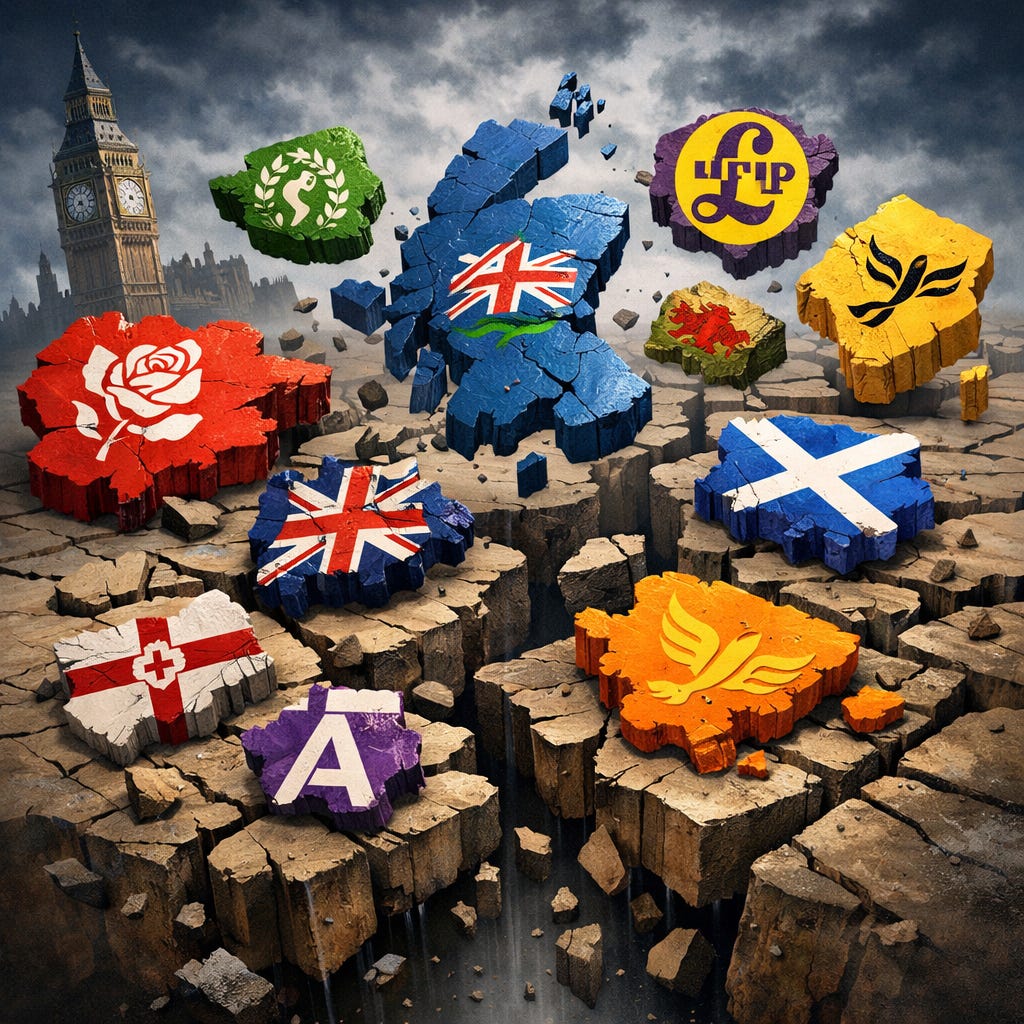
The British are supposedly a phlegmatic race, not given to revolutionary fervour or radical politics. The UK is the oldest parliamentary democracy in the world and has had a remarkably stable political system dominated by two class-based parties, Labour and Conservative, for the last century.
Brits have a healthy disrespect for politicians and love to laugh at the antics of the pompous elites who tell them how to live their lives. But their instinct has always to look to stability and common sense; not getting too “het up” about politics. “Keep Calm and Carry On”, as the wartime slogan put it.
Until now.
Britain is het up about politics, very het up. The Labour–Tory centrist duopoly has been shattered. Old political allegiances have been broken. Voters are angry, really angry, in a way unseen even in the confrontational 1970s, when the trade unions turned the factories of Britain into a battleground from which they never fully recovered. Margaret Thatcher may have seemed a radical to many, but the Tory Prime Minister of the 1980s was essentially a centrist suburbanite committed to the political and social consensus.
The new party of the right is a very different creature. From almost nowhere two years ago, Reform UK, led by a right-wing maverick and left-wing hate figure, Nigel Farage, has broken through the “uniparty”, as he calls the Labour–Conservative duopoly. Reform has been leading the UK opinion polls by a double digit margin for most of the last six months. It could very well be the next government of the UK. This is not normal.
Forget Farage’s avuncular style. Reform is a very radical right wing pasty. It stands for mass detention and repatriation of illegal immigrants; a “net zero” cap on legal migration; resumption of drilling for oil and gas in the North Sea; and an end to transgender ideology in schools and the public sector. It is currently in a strong position to win next month’s crucial Gorton and Denton by-election, in what used to be one of Labour’s safest seats.
But it won’t be without a fight. The Green Party, led by a left-wing populist, Zack Polanski, is coming up fast in this Manchester seat. Their candidate here is a local councillor, Hannah Spencer. The Greens are appealing to the large Muslim population in the Manchester seat by foregrounding opposition to “genocide” in Gaza. The Greens’ deputy leader, Mothin Ali, famously shouted “Allahu Akbar” after his victory speech in a 2024 council election.
Under Polanski’s leadership, the Greens have largely sidelined the environment in favour of policies welcoming more refugees, nationalising large parts of the economy, imposing punitive wealth taxes leaving NATO and moving towards “a world without borders”.
Gorton and Denton is looking like a microcosm of the Great Fragmentation of UK politics. These radical right and left parties are a departure from the centrist tradition of UK politics. Reform’s candidate, the former academic, Matt Goodwin, is the most anti-immigration politicians who has stood for office arguably since Enoch Powelln in the 1960s. He is unashamedly hostile to Muslim immigration, blames asylum seekers for rape, murder and violence against women. He famously said that being British requires “more than a piece of paper”. He is generally described, fairly, as an ethno-nationalist who believes that multiculturalism is undermining British culture and must be halted.
The latest opinion poll on voter intentions in Westminster from Find Out Now is unreliable since it had a very small sample. Nevertheless its message is intriguing. It has Reform UK leading on 29%, followed by the Green Party on 19%. Labour and the Conservatives are tied for third place on 17%. The old centrist party, the Liberal Democrats, are on 11%. It has the ring of truth as Private Eye used to say. The bookmakers and betting markets certainly seem to endorse it, with the Greens the odds on favourite to win the Gorton and Denton by-election on February 26th with Reform second favourite.
These are not reliable indicators of anything of course. There is a long way to go and Labour has deep roots in Manchester. However, Labour’s collapse is undeniable and a rebuke to the Labour PM, Keir Starmer, who won what looked like a landslide election victory only 18 months ago. In reality, it was more a vote against the chaotic Conservatives than a positive vote for Labour.
Starmer has become even more unpopular than his Tory predecessor, Rishi Sunak; more unpopular than Donald Trump;and more unpopular even than Liz Truss, the former Tory PM who caused a crisis in the bond markets with her ill-thought-out budget in 2022. The Starmer administration has plumbed new depths of governmental chaos with thirteen major U-turns in as many months. And now another Technicolor scandal involving Petet Mandelson
Broken promises not to raise taxes have caused a crisis of trust and damaged economic growth. The PM’s failure to stop migrant boats crossing the Channel has infuriated British voters, who are not instinctively racist but feel that allowing 50,000 undocumented young men, often from countries mired in violence, to enter the country illegally every year is simply irresponsible.
The cost of living continues to rise. Domestic fuel costs are some of the highest in Europe despite promises to reduce bills by £300. Starmer has allowed welfare spending to soar inexorably and unaffordably. The National Health Service has failed to improve its dismal performance despite huge investments of public funds. Starmer’s promise to hold a national inquiry into the mass rape of white girls by mainly Pakistani grooming gangs has yet to materialise, a year after Elon Musk on X shamed the government into addressing this long-running scandal.
The Conservatives, meanwhile, are in an even worse predicament than Labour, trailing the polls in an unhealthy fourth place. The Tories have lost a raft of former cabinet ministers to Reform, including the former Home Secretary Suella Braverman, former leadership contender Robert Jenrick, and former Tory Chancellor Nadhim Zahawi. The Conservative Party leader, Kemi Badenoch, has won plaudits for her recent performance in Parliament, but her party has lost so many key figures that people now say Reform looks like the Tory party in exile.
People are shattered
The roots of the Great Fragmentation in UK politics lie deep. In July, the polling organisation More in Common published the results of a mega-survey of 20,000 British adults. Its conclusion was that Britain is simply “shattered”. The public feel exhausted and on the verge of psychological breakdown.
Seven in ten voters believe the country is on the wrong track. Nearly nine in ten have lost faith in politics. Nearly half say they are “surviving, not living” because of the raging cost of living (median earnings in Britain are 30% lower than in the US). Scepticism about politicians has morphed, in many cases, into “deep-seated contempt”, say the pollsters. And it is not just politicians. Brits no longer respect the police, judiciary, journalists or business leaders.
Many voters are furious at the way both Labour and the Conservatives colluded in mass immigration despite voters repeatedly saying they opposed it. Net migration to the UK rose to nearly one million in 2023 under the Conservatives. This influx has been transforming the culture of England and creating introverted multicultural enclaves in many big cities, such as Manchester. The pollsters concluded that Britain is ready, for the first time in modern history to “roll the dice on something new”.
Most of the legacy media still seem to think that all this fragmentation is a temporary phenomenon and that normal service will be resumed before the next general election. After the 2024 general election, commentators, including the BBC’s former political editor Andrew Marr, opined that the election of Labour would presage a period of “stable and sensible government” after the chaotic Tory years, bringing a tide of investment to Britain as a haven from Trumpian madness in America and the rise of the far right in Europe.
He could not have been more wrong. Britain may be a newcomer to confrontational populist politics, but it is learning fast, and with the enthusiasm of the convert. The Brits have learned to live dangerously.